
Updated by the Velox team
You need somewhere to store your belongings during a move, renovation, or life transition. Two main options keep coming up: traditional self storage facilities and portable storage containers. Both solve the basic problem of needing extra space, but they work very differently.
The choice between self storage vs portable containers affects more than just where your stuff sits. It impacts how much time you spend loading and unloading, how often you’re driving across town, how flexible your timeline can be, and ultimately how much stress the whole process creates.
Neither option is automatically better for everyone. The right choice depends on your specific situation, timeline, and priorities. But understanding how they compare helps you make a decision that actually fits your needs instead of just picking whichever option you hear about first.
Here’s an honest look at portable storage versus traditional self storage, covering what matters most when you’re trying to move or store belongings without losing your mind in the process.
How Each Option Actually Works
Traditional self storage means renting a unit at a storage facility. You drive there, load or unload your belongings, lock up the unit, and leave. The unit stays at the facility, and you visit whenever you need access to stored items. You’re responsible for all the transportation between your home and the storage facility.
Portable storage containers get delivered to your location. You load the container at your own pace, usually in your driveway. When you’re done, the container either stays on your property or gets picked up and stored at a secure facility. When you need your belongings again, the container comes back to you. You’re only handling items once at each end instead of multiple times.
This fundamental difference in how the process works affects everything else about the experience.
Not sure about your spot? See if the container fits in your driveway in 3D before delivery day.
Convenience and Time Investment
With traditional self storage, every interaction requires a trip. You drive to the facility to drop off items, drive there again when you need something, and drive there repeatedly throughout your storage period.
During a move, this means loading your car or truck at home, driving to the storage unit, unloading everything, driving home, and repeating this process multiple times until everything’s stored. When you’re ready to retrieve items, you reverse the entire process.
Portable storage units eliminate most of these trips. The container comes to you. You load it once, right from your home. No driving back and forth. No loading and unloading your vehicle multiple times. You pack the container the same way you’d pack a moving truck, but you have days or weeks to do it instead of hours.
For busy families, this time savings is significant. Between work, kids, and everything else competing for your attention, not spending entire weekends driving back and forth to a storage facility makes a real difference.
The convenience factor increases even more if you’re moving between homes with a timing gap. Portable containers can be loaded at your old home, stored while you’re between places, then delivered to your new home for unloading. You never have to visit a storage facility at all.
Flexibility and Timeline Control
Traditional storage facilities typically require monthly contracts. You can usually rent by the month with some flexibility, but you’re working around facility hours for access and dealing with lease terms that may or may not fit your actual needs.
Portable storage offers similar monthly rental flexibility but with more control over logistics. The container stays as long as you need it, and you coordinate pickup and delivery based on your timeline, not the facility’s schedule.
If your move timeline changes, portable containers adapt more easily. Closing date pushed back? The container can stay longer. Ready to move sooner than expected? Pickup can usually be scheduled quickly.
This flexibility matters during unpredictable situations like home sales, construction projects, or job relocations where timelines shift unexpectedly.
Access to Your Belongings
Self storage facilities usually offer twenty-four-hour access with a keypad or code. You can visit your unit anytime, day or night, without coordinating with staff. For people who need frequent access to stored items, this availability is valuable.
Portable storage containers handle access differently. If the container is at your home, you have unlimited access on your schedule. Open it whenever you want, as often as needed. If the container is stored at a facility, you schedule access ahead of time during business hours.
For most moves, unlimited facility access sounds better than it actually is in practice. How often do you really need to visit a storage unit at two in the morning? Most people access storage a handful of times during their entire rental period, making scheduled access perfectly adequate.
The convenience of having the portable container delivered to your home for loading and unloading typically outweighs the flexibility of twenty-four-hour facility access for traditional storage units.
Cost Comparison
Comparing costs between portable storage and self storage requires looking beyond just the monthly rate. The total expense includes rental fees, transportation costs, and the value of your time.
Traditional self storage monthly rates vary widely based on unit size and location. Smaller units might run less per month than portable containers, but you’re paying for fuel, vehicle wear, and your time making repeated trips. If you need to rent a moving truck to transport larger items, those costs add up quickly.
Portable storage containers include delivery and pickup in most pricing structures. You’re paying slightly more per month in many cases, but you’re not making trips or renting trucks. The container comes to you, you load it once, and that’s it.
For a typical move with a few weeks of storage needed, total costs often end up comparable between the two options. Portable storage may cost slightly more upfront, but when you factor in gas, truck rental, and the value of your time, the difference shrinks or disappears.
For longer-term storage of several months or more, traditional self storage might pencil out cheaper on paper. But you’re still dealing with access trips whenever you need something, which adds costs and hassle over time.
Physical Effort Required
Loading and unloading a self storage unit means handling every item multiple times. You carry items from your home to your vehicle, drive to the facility, carry items from your vehicle to the storage unit, and reverse this entire process when retrieving items.
For a full household of belongings, this represents significant physical work. Furniture, boxes, and heavy items get lifted, moved, and positioned multiple times. If you’re not physically capable of doing this work yourself, you’re hiring movers or asking friends and family for repeated help.
Portable storage containers reduce this physical effort dramatically. You load items once, directly from your home into the container sitting in your driveway. When the container reaches your new home, you unload once. That’s it. Items are handled twice total instead of four or more times.
For anyone with physical limitations, older adults, or people recovering from injuries or surgery, this reduction in physical effort can make the difference between managing the move independently or needing extensive help.
Space Efficiency and Organization
Self storage units come in standard sizes. You rent the size you think you need, but you might end up with too much space or not enough. If you outgrow your unit, you have to rent a second one or upgrade to a larger size, which may not be available.
Inside the unit, organization is up to you. How you stack and arrange items affects how accessible things are. Creating pathways to reach items at the back of the unit reduces usable space.
Portable storage containers also come in standard sizes, with similar challenges around estimating what you need. But because the container comes to you, it’s easier to judge whether you’re fitting everything efficiently as you load. If you realize you need more space, arranging for a second container or a larger size is straightforward.
The loading process itself tends to be more efficient with portable containers because you’re packing directly from your home. You can make multiple trips between your house and the container in your driveway, taking time to organize and stack efficiently without feeling rushed.
Security Considerations
Traditional storage facilities offer varying levels of security. Gated access, cameras, and individual unit locks provide protection, but you’re sharing the facility with many other people coming and going at all hours.
Break-ins at storage facilities do happen, though they’re relatively uncommon at reputable facilities with good security measures. Still, you’re trusting facility security rather than controlling it yourself.
Portable storage containers kept at your home provide security you control directly. The container sits on your property, and you’re the only one with access. Use your own lock, and no one gets in without your permission.
Containers stored at a Velox facility are secured in a monitored location with limited access. You’re not sharing the space with random people coming and going, and the facility is designed specifically for container storage rather than high-traffic self storage.
For valuable items or belongings with sentimental value, many people feel more comfortable with the security arrangement portable containers offer.
Loading Help and Equipment
Self storage facilities provide carts and dollies for moving items within the facility. Some have elevators if units are on upper floors. But you’re responsible for getting items to the facility and moving them from your vehicle to the unit.
If you need professional loading help, you’re hiring movers separately and coordinating their schedule with your facility access.
Portable storage simplifies this process. The container sits at ground level in your driveway. No stairs, no elevators, no pushing carts across parking lots. Load directly from your home using whatever equipment or help you arrange.
If you hire professional packers or movers, they come to your home once, load the container, and they’re done. No coordinating facility access or timing around facility hours.
Weather Protection
Both self storage and portable containers protect belongings from weather, but the specifics differ.
Climate-controlled self storage units maintain consistent temperature and humidity year-round. This offers the best protection for temperature-sensitive items or belongings stored long-term in climates with extreme weather swings.
Standard non-climate-controlled storage units protect from rain and snow but experience temperature variations similar to being in a garage. For most household items, this level of protection is adequate.
Portable storage containers are weather-sealed to keep out moisture but aren’t climate-controlled. Interior temperatures vary with outside conditions, similar to a garage or shed. For most moves and storage situations in Utah, this provides adequate protection with proper packing.
If you’re storing items particularly sensitive to temperature or humidity for extended periods, climate-controlled self storage might be worth the premium. For typical household moves and short-to-medium-term storage, weather-sealed portable containers protect belongings just fine.
Best Situations for Each Option
Traditional self storage makes the most sense when you need very long-term storage without any moving component, when you need climate control for sensitive items, or when you require frequent access to many different stored items.
Portable storage containers excel for moves with timing gaps between homes, home renovations where you need belongings out of the way temporarily, any situation where you want to avoid repeated trips to a facility, or when physical limitations make multiple loading sessions impractical.
For most residential moves, downsizing, or temporary storage during life transitions, portable containers offer a better overall experience. The convenience and time savings outweigh any small cost differences, and the reduced physical effort makes the whole process more manageable.
What Utah Families Actually Choose
In practice, many Utah families find portable storage fits their lives better than traditional self storage. The growing population, busy schedules, and prevalence of single-family homes with driveway space make portable containers a natural fit.
Not having to drive across the Salt Lake Valley or fight traffic in Utah County just to access stored belongings appeals to people who are already juggling packed schedules. The ability to pack slowly and carefully at home instead of rushing through loading at a facility reduces stress during already complicated moves.
Local companies like Velox make portable storage even more attractive by offering direct communication with owners rather than call centers, flexible scheduling that works around customer needs, and service that feels more personal than corporate storage chains.
A Quick Checklist: Is Portable Storage Right for You?
- You would rather load once than load a truck, unload at a unit, and do it all again later.
- Your dates are not firm: a closing, a remodel or a build that could run long.
- You want your things at home where you can reach them, or you have no driveway space and want them at a gated yard instead.
- You do not want to drive a rental truck.
A self-storage unit can be the better fit if you only have a few boxes, or if you need to get into your things every day and have no room for a container at home.
Making Your Decision
Choosing between portable storage and self storage comes down to what matters most for your specific situation. If you need climate control and unlimited facility access, traditional self storage might be the answer. If you value convenience, time savings, and reduced physical effort, portable containers probably make more sense.
Think about your timeline. How long do you need storage? How often will you need to access items? Do you have space at your home to keep a container on-site?
Consider your physical capability and available help. Can you handle loading and unloading multiple times? Do you have friends or family to help with repeated trips, or will you be doing this yourself?
Factor in your schedule. Do you have time for multiple trips to a storage facility, or would you rather load once and be done?
Be honest about what will actually make this process easier for you. The option that sounds cheapest on paper might end up costing more in time, effort, and stress.
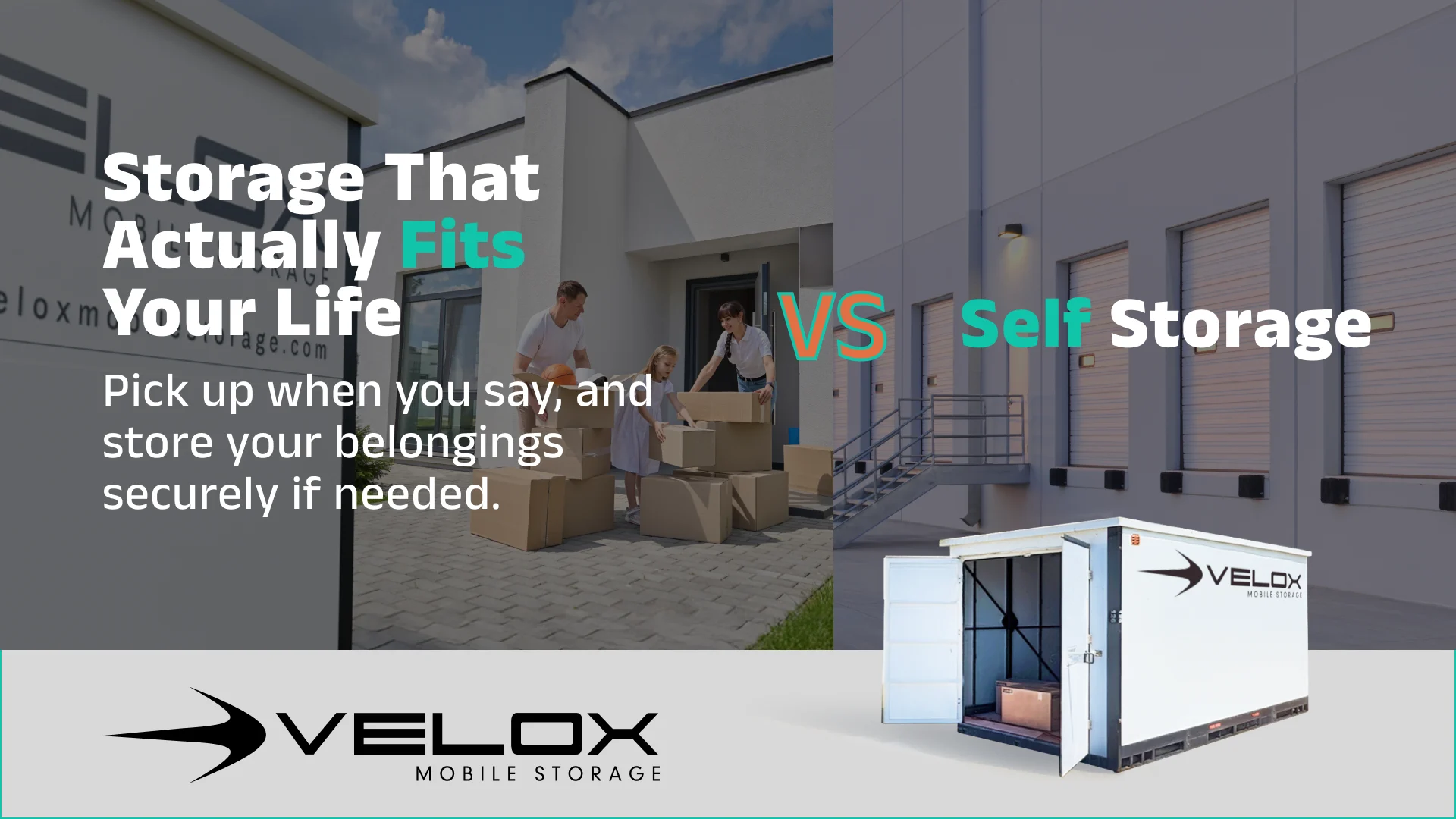
Storage That Actually Fits Your Life
At Velox, we believe storage should work around your needs, not the other way around. Portable containers give Utah families flexibility, convenience, and control during moves and life transitions.
We deliver when you’re ready, pick up when you say, and store your belongings securely if needed. You’re not locked into rigid schedules or fighting traffic to access a storage facility across town.
Click here for a free, no-obligation quote, or call us at 801-362-9978 to discuss whether portable storage makes sense for your situation. We’ll be honest about what works and what doesn’t, because the goal is finding the right solution, not just making a sale.
Because moving and storage are complicated enough without the storage company making it harder.