
How It Works
How Portable Storage Works, Start to Finish
Storage that comes to you
Velox is portable storage with one container size and one simple process: we deliver an 8×16 steel container to your driveway or job site, you load it on your own schedule, and when you’re done we pick it up, move it to your new address, or store it at one of our yards.
Our own trucks run from our own yards in Springville and Pleasant Grove in Utah County, and Brighton in the Denver area, so you’re dealing with a local crew and the owner, not a call center. Here’s the whole thing, start to finish.
The four steps
1. Get a quote and pick a delivery day
Call or send the quote form with your delivery address, roughly how long you’ll need the container, and whether it’s staying on site or coming to our yard. You get both numbers, the monthly rate and the move fee, before you book. Next-day delivery is common in Utah County and the Denver metro, and a morning request can sometimes go out the same afternoon. Farther locations are scheduled with the quote. See how pricing works.
2. We deliver and place it
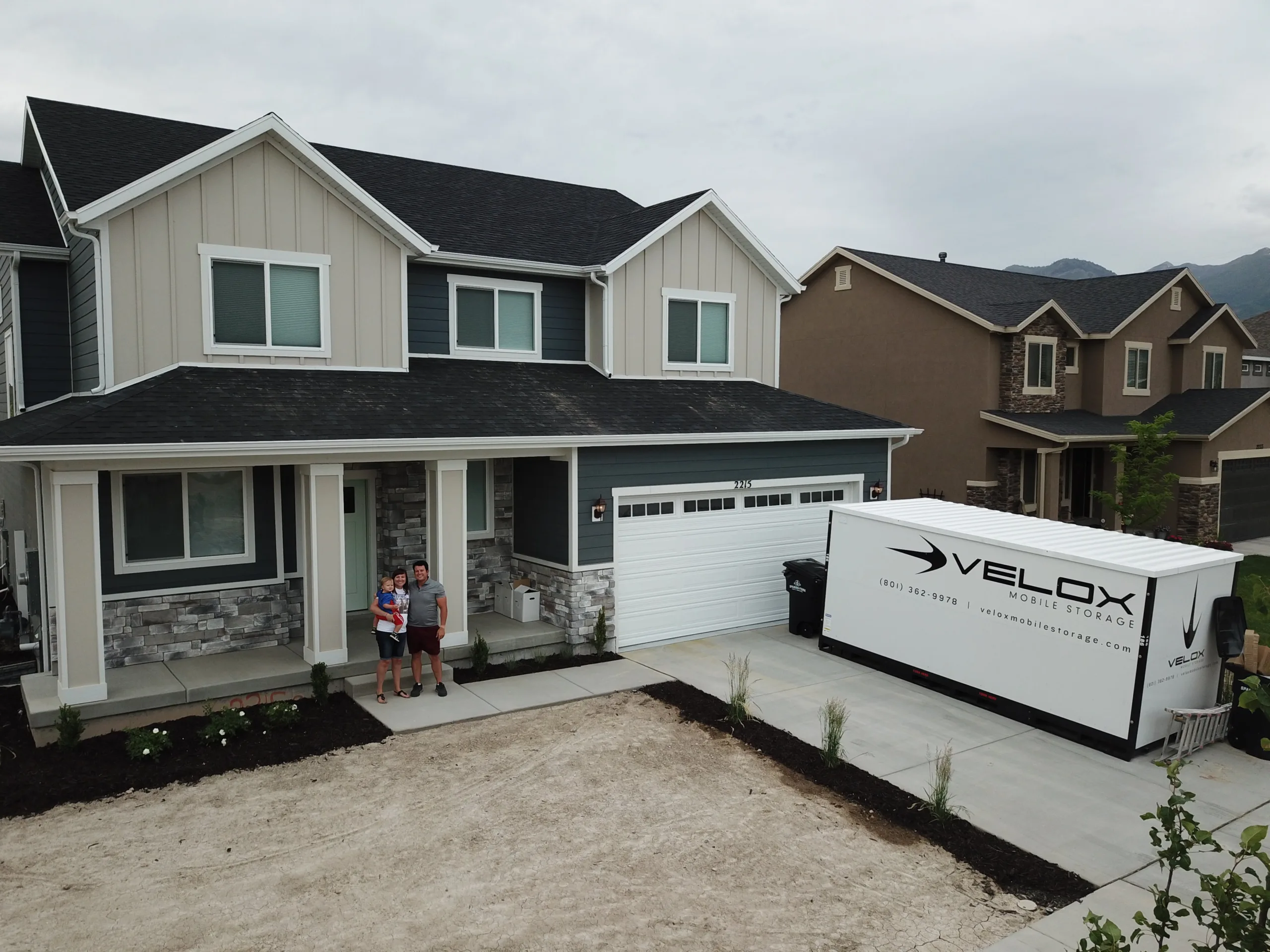
The truck arrives in your scheduled window, the driver checks the spot, and the container is lowered onto the ground from a hydraulic bed. Placement takes about 15 to 30 minutes when the spot is ready. Tell us where you want it and it goes there, within what your driveway or site allows. Will it fit in my driveway?
3. Load it at your own pace
No truck rental, no moving-day sprint. The container sits in your driveway for as long as you need it, month to month, and you fill it a room at a time. Keep it locked when you’re not loading; every unit has lockable doors. Put heavy items low and spread across the floor rather than stacked in one corner, so the container rides safely when it moves. How long does loading take? See what fits inside.
4. Tell us what’s next: pick up, move it, or store it
When you’re done, one call schedules the next move. Three options:
- Pick it up. Unloaded and finished? We collect the empty container. That’s the standard two moves: delivery and pickup.
- Move it loaded. Relocating? We haul the loaded container to your new house or second site and set it down there. You load once and unload once.
- Store it at our yard. Between homes or mid-remodel? We bring the loaded container to our gated, secured yard and hold it. The monthly rate is the same as in your driveway; you only add the move fees in and back out.
Get a Fast Quote — It Takes 2 Minutes
Utah: (801) 362-9978 · Denver: (720) 674-8777
Delivery day: what to have ready
Most deliveries are uneventful because the spot was ready. Four things to check before the truck comes:
- Room to work. The container is 8 feet wide and 16 feet long, and the truck needs a straight, clear run from the street to the spot. Cars moved, bins and toys out of the way.
- Overhead clearance. Look up: power lines, low branches, roof overhangs and awnings along the path and over the spot.
- Level, solid ground. A concrete driveway is ideal. Soft soil, steep slopes and uneven ground are a problem once the container is loaded and weighs thousands of pounds.
- Gates and side yards. A standard 3- or 4-foot side gate won’t pass an 8-foot container. If it’s going behind the house, measure first.
Full checklist: how to prepare for your delivery.
Permits and HOAs
Most driveway placements don’t need a permit. Street placement usually does, and some HOAs want notice or written permission first. If you’re not sure, ask when you book; we’ve placed containers in most of the cities we serve. Utah County permit guide.
Moving to southern Utah?
A common Utah move: you’re leaving the Wasatch Front for the St. George area, but the new place isn’t ready yet. We store your loaded container at our yard until it is, haul it down, you unload, and the empty unit rides back with us on the same trip, so you skip the final pickup fee. Ask about it when you get a quote.
While it’s stored
In your driveway: it’s yours to open whenever you like. Keep it locked when you’re not loading or unloading.
At our yard: call ahead to schedule access; a day’s notice is typical, and we’ll have the unit ready during business hours (Mon–Sat, 8 AM–6 PM). It’s not a keypad self-storage facility, so plan ahead rather than dropping in. How access works.
Weather: the container is all steel and weather-sealed, built to sit outside through a Utah or Colorado winter. What happens when it snows.
How It Works FAQ
How big is the container?
8 feet wide by 16 feet long: it takes up about 128 square feet of ground and has about 800 cubic feet of space inside. It holds 3–4 rooms of furniture and boxes. One size for everyone, which keeps the pricing simple. What fits in an 8×16.
Is there a weight limit?
Yes. Our containers move safely loaded with up to 7,500 pounds, and a fully furnished two- or three-bedroom home loaded evenly is usually under that. Ask us before loading dense materials like tile, brick or paper archives. Weight limit guide.
How long can I keep it?
As long as you need. Rentals are month to month with no contract and a one-month minimum, billed by the full month, and there’s no penalty for returning early or extending.
Can you move the container once it’s loaded?
Yes. A loaded relocation to a new address, or to our yard, counts as a third move; the fee depends on where it’s going.
What’s included?
The container, delivery and placement, pickup when you’re done, and month-to-month billing. Content insurance, unit protection and a lock are optional add-ons shown on your quote.
Where do you deliver?
Most of Utah, with the shortest runs in Utah County, and the Denver area from Fort Collins to Colorado Springs. Utah service area · Colorado service area.
Ready to get started?
Tell us your address and how long you’ll need it. You’ll have a quote in a couple of minutes, and a container in your driveway as soon as tomorrow in most of Utah County and the Denver metro.
Scheduling and Changing Your Dates
- Booking: tell us the address and the date you want. Next-day delivery is often possible. Book earlier for Fridays, month-end and the days before a holiday.
- Changing a date: call or text. It is fine unless the truck is already on its way.
- Being home: not required if the placement instructions are clear. The driver contacts you before arriving. Plan to be there if the spot is tight or unusual.
- Pickup: any time after the one-month minimum. Loaded-container moves are scheduled ahead of empty deliveries.