
November 26, 2025
Updated by the Velox team

Most advice about portable storage is about packing — load heavy things low, fill the gaps, don’t stack boxes badly. That advice is fine, and we’ve written plenty of it. But packing is not where people actually lose money.
The expensive mistakes happen earlier. They happen when a container gets delivered to a city that doesn’t allow it, or set on a corner lot where it blocks a sight line, or parked on a driveway the truck can’t reach. By then you’ve paid for a move, and fixing it means paying for another one.
Here is what we see go wrong, from running our own trucks out of Springville, Pleasant Grove and Brighton.
You can also check whether a container fits your driveway with our 3D tool. Pick a spot like yours and move the container around.
1. Assuming your city allows a container in your driveway
Most Utah County cities are fine with a container on your own driveway. Two are not straightforward, and both of them surprise people.
Orem prohibits portable containers on residential lots. The city code names shipping containers, semi-trailers, boxcars and PODS specifically. There is no temporary moving exception written into it. Enforcement is complaint-driven, which means plenty of containers sit in Orem driveways without incident until a neighbor calls — and then it’s your problem, on a schedule you don’t control.
Provo allows them, but only for 30 days in any 12-month period. If you have an active building permit the container can stay for the life of that permit, but it has to be gone before your certificate of occupancy. If your remodel runs long — and remodels run long — 30 days arrives faster than you’d think.
Everywhere else in Utah County, we haven’t found a container-specific residential rule. That’s not the same as “it’s definitely allowed,” it means the code is silent. Our Utah County permit guide goes city by city with the code sections and the planning department phone numbers.
In Colorado, a container on your own property in Denver generally needs no city permit. The suburbs — Aurora, Lakewood, Arvada, Westminster, Thornton, Littleton — each set their own rules through their own public works departments, and Denver’s process doesn’t carry over. The Denver permit guide covers it.
2. Putting it on the street without checking what that costs
Driveway and street are two completely different legal situations, and people treat them as the same decision.
Every city we’ve looked at treats the public right-of-way more strictly than private property — and the right-of-way often extends several feet past the curb, onto what looks like your lawn. A container you think is on your grass can be in the public way.
The costs are real. Springville’s encroachment permit is $375, plus $65 for each additional day. American Fork’s right-of-way permit is $150. Provo doesn’t allow containers in the public right-of-way at all, including the street and the sidewalk. Pleasant Grove requires express permission of the City Council for street placement, which is not a same-week process.
In Denver, street or sidewalk placement needs a right-of-way occupancy permit from the Department of Transportation and Infrastructure.
None of this makes street placement a bad idea — sometimes it’s the only option. It just needs to be a decision you make on purpose, with the cost in the budget. The driveway is almost always the cheaper, simpler answer.
3. Forgetting that a corner lot has invisible rules
This one catches people who did everything else right.
Most cities ban anything over three feet tall inside a “clear vision triangle” at an intersection — the area a driver needs to see through. A Velox container is about eight feet tall, so it fails that test everywhere, every time.
The triangles differ by city: Provo and Orem measure 25 feet from the intersection, Lehi 35 feet, Pleasant Grove uses the building setback line. Springville goes further and applies a vision triangle to driveways — 15 feet from the front property line and 30 feet either side of your driveway’s centerline.
If you’re on a corner, measure before you book. There is usually still a legal spot on the lot; it just may not be the spot you had in mind.
4. Measuring the spot but not the path to it
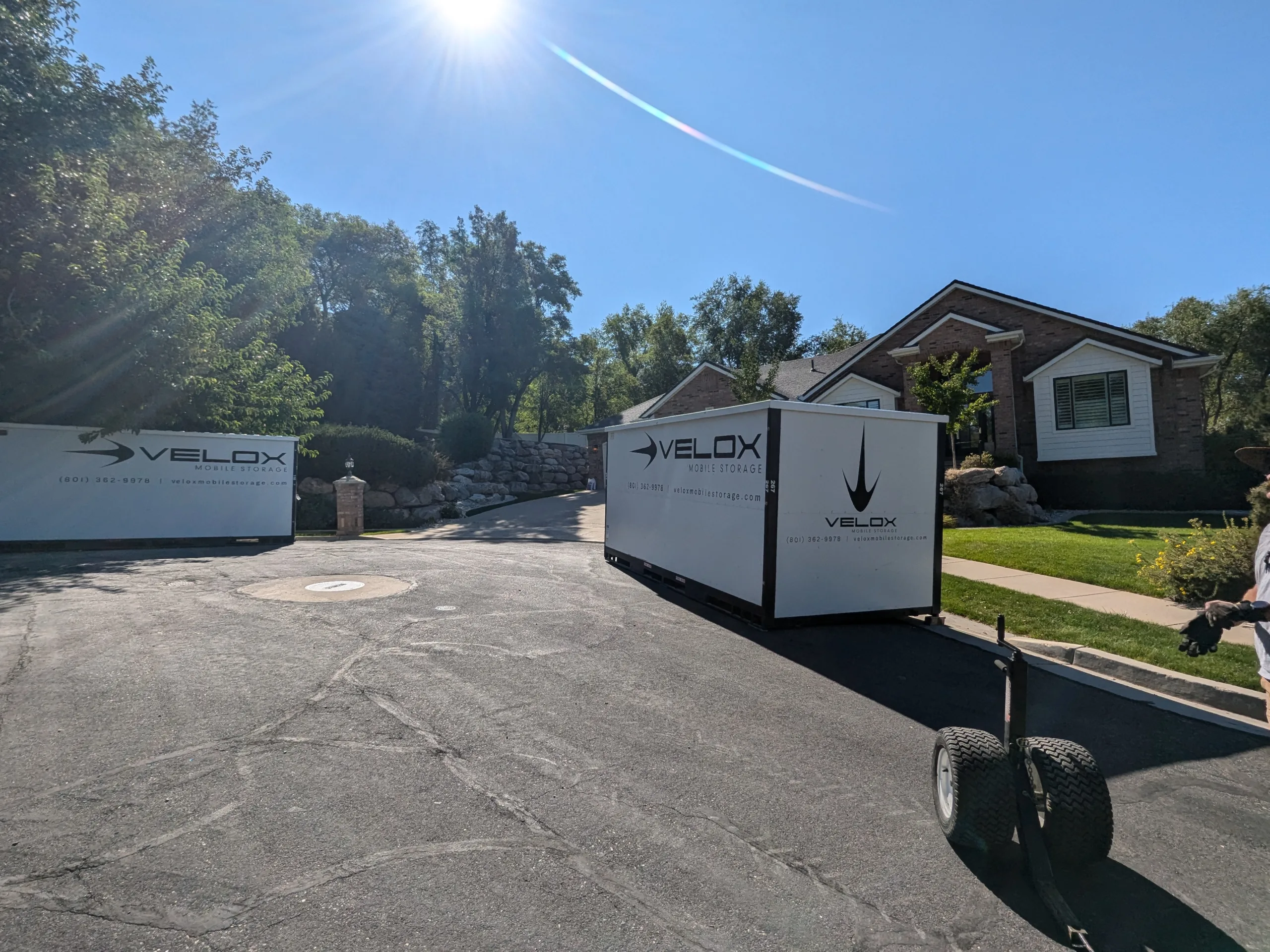
The container is 8 feet wide and 16 feet long — about one parking stall. People measure that footprint, confirm it fits, and book.
Then the truck arrives and can’t get to it.
Our truck needs a straight, clear run from the street to the placement spot. Cars, trash bins, basketball hoops and kids’ toys all have to be out of the way before we arrive, not while we’re standing there.
The one that ends deliveries most often: a standard 3- or 4-foot side gate will not pass an 8-foot container. If your plan is to put it in the back yard, measure the gate first. We’ve had people take a fence panel out, which works — but it’s better to know a week ahead than on delivery morning.
If the spot is tight or unusual, text us a photo. It takes a minute and it’s the fastest way to get a real answer. We’ve placed units on gravel pads, job sites, inside garages and once on a football field, so “unusual” doesn’t scare us — being surprised on the day does.
5. Looking down, but not up
Everyone checks the ground. Almost nobody checks overhead.
Power lines, low branches, roof overhangs and awnings all have to clear — not just over the final spot, but along the entire path the truck travels to reach it. A branch that a car passes under comfortably is not the same clearance a container truck needs.
This is a five-minute walk of the route with your head up, and it prevents a wasted trip.
6. Putting it on ground that can’t hold a loaded container
Empty, the container is manageable. Loaded, a typical unit weighs 3,000 to 4,000 pounds, and the limit is 7,500.
Concrete and asphalt are ideal. Compacted gravel, crushed rock, dirt and grass all work if they are firm, level and dry. The problems are soft soil, fresh landscaping and slopes — soft ground that holds an empty container fine can sink under a loaded one, and a slope that looks gentle is a different matter with two tons sitting on it.
Slopes we review case by case, so send a photo. If you have decorative pavers or concrete poured in the last year, tell us before delivery and we’ll pick a spot that won’t risk it. Damage is rare — the container is lowered by machine, never dropped or dragged — but the way to keep it rare is to know what we’re setting it on.
7. Skipping the HOA
Your city can say yes and your HOA can still say no.
HOAs can set shorter time limits than the city, require architectural committee approval, or ban anything visible from the street. Gated communities and private developments set their own rules for their internal streets regardless of what the city allows.
The important part: HOA fines and liens are a private matter, and the city cannot waive them. Being within city code is not a defense. Check the covenants, or ask the board, before you book — not after the first letter arrives.
8. Booking a June delivery in June
Late May through mid-August is our busiest stretch, every year, in both states.
Next-day delivery is common in Utah County and the Denver metro, and a morning call can sometimes go out the same afternoon. That is true in February. In peak summer, loaded containers get priority over empty deliveries, so an empty drop-off can wait.
If your move is in summer, book a week or more ahead. If your dates move — and they do — you can reschedule by call or text any time before the truck leaves.
9. Sending it to the yard when you actually need to get into it
Our yards are gated and secure, and storing your container there costs no more per month than keeping it in your driveway. For most people that’s the right call.
But yard storage is not keypad self-storage. Access is by appointment during business hours, Monday through Saturday, 8 AM to 6 PM, and a day’s notice is typical. Someone meets you, opens the gate, and locks up after. Visits should be reasonably short.
That’s a good arrangement if you need your things back in a month. It’s the wrong arrangement if you’re going to want a box out of it every weekend. If you need regular access, keep the container at home. People who get this backwards end up paying for a loaded move to bring it back to the driveway — which counts as a third move, on top of delivery and pickup, with its own fee.
10. Leaving insurance until after the container arrives
Coverage on your belongings is required, and there’s a clock on it.
Either your renters or homeowners policy covers items in portable storage — in which case we need proof within five business days of delivery — or you enroll in the Storage Protectors contents plan, which covers from $2,000 to $20,000 against theft, fire, windstorm and smoke. It does not cover flood.
The mistake is assuming your existing policy automatically extends to a container in your driveway. Many do. Some don’t, and some only do while the container is on your property and not while it’s in a yard. One call to your agent before delivery settles it, and it is a far better call to make then than after something happens.
The three that cost the most
If you only check three things before you book:
- Your city’s rules — especially if you’re in Orem or Provo, or on a corner lot.
- The path, not just the spot — gate width, overhead lines, a clear run from the street.
- Your HOA covenants — because the city saying yes doesn’t mean the HOA will.
Everything else on this list is recoverable. Those three can mean paying for a move you can’t use.
Once the container is in the driveway
Packing is the part that’s hard to get badly wrong, and we’ve covered it properly elsewhere:
- How to organize a portable storage unit — layout, labeling, stacking
- Packing tips for maximizing space — load order and weight balance
- What can and can’t go in — prohibited items and gray areas
- How long it takes to load — pacing a load over days
- Preventing mold and moisture — these units are weather-sealed, not climate-controlled
Frequently asked questions
Can I put a portable storage container in my driveway in Orem?
Orem’s code prohibits portable containers on residential lots, naming shipping containers, semi-trailers, boxcars and PODS. There’s no temporary moving exception written into it. Enforcement is complaint-driven. If you’re moving in or out of Orem, call us and we’ll talk through the options — in many cases the container can sit at one of our yards and we move it loaded instead.
How long can a container stay in a Provo driveway?
30 days in any 12-month period under Provo City Code 14.34.355. With an active building permit it can stay for the life of the permit, but it must be removed before the certificate of occupancy is issued. One container per lot, no stacking, and never in the public right-of-way.
Do I need to be home for delivery?
No, as long as the placement instructions and access are clear. The driver calls before arriving. For tight or unusual spots, being there — or texting a photo beforehand — makes it go smoothly.
Will the container damage my driveway?
Damage is rare. The container is lowered from a hydraulic bed by machine, not dropped or dragged, and placement takes 15 to 30 minutes. Tell us about decorative pavers or recently poured concrete so we can choose a safe spot.
What happens if I don’t get a permit for street placement?
Code enforcement in these cities is generally complaint-driven, and the usual first step is a written notice with time to correct it. Fines escalate if the container stays. The exception is Orem, where residential placement itself is prohibited rather than just unpermitted.
Can I move the container to a new address after it’s loaded?
Yes — the containers are built to be moved fully loaded, up to 7,500 pounds. A loaded relocation counts as a third move beyond delivery and pickup, and the fee depends on the destination. Mention dense loads like safes, machinery or pallets of tile when you book.
Get it right the first time
We’re a local team, in Utah County and the Denver metro, and we’d rather spend ten minutes on the phone before you book than send a truck to a spot that won’t work.
Text us a photo of where you’re thinking of putting it. We’ll tell you straight whether it fits, whether your city is going to be a problem, and what it’ll cost.
Utah: (801) 362-9978 · Colorado: (720) 674-8777